
From Pathways to Paychecks: The Next Phase of CTE Leadership

The Question Leaders Should Be Asking Now
At this point, most leaders in Career and Technical Education are not asking whether pathways work.
They do.
The evidence is clear. Participation has expanded. Programs are more aligned with the industry. Work-based learning is more embedded. Credentials are more relevant. In many states and districts, CTE has moved from the margins to the center of education and workforce strategy.
That conversation is largely settled.
The more important question now is different.
What happens after students complete those pathways, and how deliberately are we designing that transition?
Because the reality is this, completion has improved. Employment transition has not kept pace.
That gap is not always visible in dashboards. It does not show up clearly in completion rates or credential counts. It becomes visible in the weeks and months after graduation, when students begin navigating systems that were not designed to function as a single system.
Where Momentum Is Being Lost
Leaders already understand the structural pieces. High-quality programs exist. Postsecondary options exist. Workforce training exists. Employers are engaged.
The issue is not the presence of these elements. It is how they connect at the point of transition.
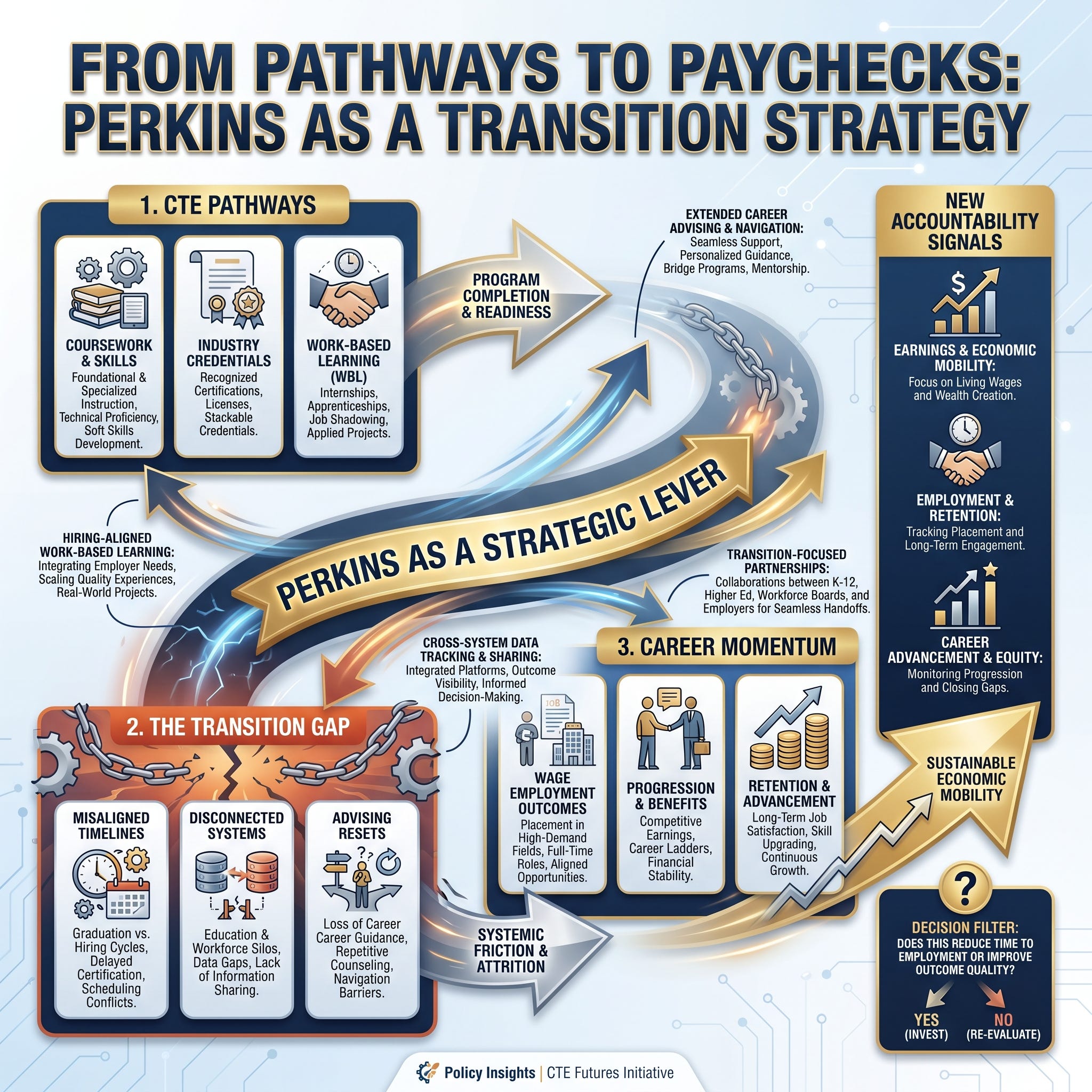
Students are still moving from one system to another rather than through a coordinated pathway. Advising often resets instead of advancing. Credits do not consistently accelerate progress. Hiring expectations are not always visible early enough. Timelines across education and workforce systems remain misaligned.
Individually, these issues appear manageable. Collectively, they create friction at the exact moment when students should be gaining speed.
This is where the concept of career momentum becomes essential.
Career momentum is not simply placement. It is the speed, clarity, and continuity with which a student moves from preparation into productive employment and onward progression. It reflects whether systems are designed around outcomes or around structures.
CTE has reached a point where this distinction matters.
The Accountability Shift That Requires a Different Response
The shift underway at the federal level reinforces this moment.
As the U.S. Department of Labor continues to strengthen its focus on employment outcomes, earnings, and retention, the expectations placed on workforce systems are becoming more explicit. It’s important not just who participates, but also who gets employed, how soon, and if it results in lasting progress.
For CTE leaders, this should not be viewed as external pressure. It should be recognized as an opportunity for alignment.
The field has already built the front end of the employment pipeline. What is now being emphasized is the back end.
The implication is clear. Systems that cannot demonstrate strong transitions into employment will increasingly face questions about effectiveness, even if their participation and completion numbers remain strong.
This is not a reason for concern. It is a reason for precision.
This shift also introduces a new level of visibility that CTE leaders should not overlook. As employment, earnings, and retention data become more integrated across federal and state systems, the transition from completion to employment will no longer be inferred. It will be observed. This creates an opportunity to move beyond assumptions and into evidence. States that begin aligning their CTE pathways with these emerging accountability signals will be better positioned to respond. They will help define how success is measured in the future.
What Should Now Be Strongly Considered
If the goal is to move from pathways to paychecks, then leadership decisions must begin to reflect that priority more directly.
At the state level, the first shift is conceptual. Transition must be treated as a design responsibility, not an assumed outcome.
That means moving beyond alignment language and into alignment mechanics.
States should begin to define and track transition intervals. How long does it take for a completer to enter employment in a related field? Where are delays occurring? Which pathways produce the most consistent outcomes? Without this level of specificity, improvement efforts will remain broad and imprecise.
The second shift is structural. Cross-system alignment cannot rely on coordination alone. It requires shared expectations.
This is where the intersection of Perkins and workforce accountability becomes critical. Perkins defines program quality and access. Workforce systems define employment outcomes. When those two are intentionally connected, states can move toward a more complete definition of success.
That connection should be visible in state dashboards, funding priorities, and program approval processes.
The third shift is operational. Timelines across systems must be aligned.
Students should not complete programs and then wait months for the next available training cohort, application cycle, or hiring window. These delays are often invisible at the policy level but highly visible to students and employers.
Aligning these timelines does not require new systems. It requires intentional coordination of existing ones.
Over time, this work should lead to a more consistent set of transition indicators. Not just whether students complete programs, but how long it takes to enter employment, whether that employment aligns with their training, and whether it leads to sustained wages and progression. These are not entirely new measures. What is new is the expectation that they be used consistently to guide system design.
Using Perkins More Precisely
Most leaders understand how Perkins funding works. The question now is how to use it more precisely to address transition.
Perkins should increasingly be directed toward activities that strengthen the connection between completion and employment.
This includes designing work-based learning experiences that function as hiring pipelines rather than isolated experiences. It includes investing in advising systems that extend through the transition period, not just through program completion. It includes strengthening data systems so states and districts can see where students go next and how quickly they get there.
It also includes supporting partnerships that operate at the point of transition.
Districts, colleges, workforce boards, and employers are already engaged. The opportunity is to focus that engagement on the moment when students move from one system to another. When that moment is structured intentionally, outcomes improve.
Perkins is uniquely positioned to support this work because it is flexible, targeted, and designed to enhance quality.
The key is focus.
A clear question should now guide that focus. Does this investment reduce the time between completion and employment, or improve the quality of that employment outcome? If the answer is unclear, the investment may still have value, but it is not directly addressing the transition challenge. This level of discipline does not limit Perkins. It sharpens its impact.
What This Means for Local Leadership
At the local level, the shift is just as important.
District leaders should begin by examining their own data differently. Not just who completes programs, but what happens next. Where do students go? How long does it take? Where are transitions smooth, and where do they break down?
This level of visibility changes decision-making.
It also changes how partnerships are structured. Employers should not only inform the curriculum. They should be engaged in defining entry points, expectations, and hiring timelines. Postsecondary partners should not only accept credits. They should align programs so students move forward without redundancy.
Advising should reflect this reality as well. Students should leave programs with a clear understanding of the next steps that are both realistic and immediate.
These are not new ideas. What is new is the level of intentionality required to make them work on a scale.
One practical starting point is to identify a small number of pathways and map the transition experience in detail. Where do students pause? Where do they wait? Where do they drop off? This level of specificity often reveals that the issue is not the absence of opportunity but its sequencing. Adjusting that sequencing can produce immediate improvements without requiring new programs or additional funding.
The Leadership Moment
CTE is not being asked to prove its value. It has already done that.
It is being asked to lead the next phase of alignment between education and the workforce.
That phase is defined by what happens after completion.
Leaders who recognize this shift early will be positioned to shape how success is defined, measured, and achieved. Those who continue to focus primarily on participation and completion will find that those measures, while still important, are no longer sufficient on their own.
This is not a departure from the core mission of CTE. It is a continuation of it.
The goal has always been to connect learning to opportunity.
The difference now is that the connection must be more deliberate, more visible, and more measurable than before.
Students have done their part.
The system now has more information, more alignment tools, and more flexibility than ever before. The expectation is no longer to build pathways alone. It is to ensure those pathways function as reliable entry points into the workforce.
And ensuring that pathways lead to paychecks, quickly and consistently, will not just define the next phase of CTE.
It will define which systems are truly working.